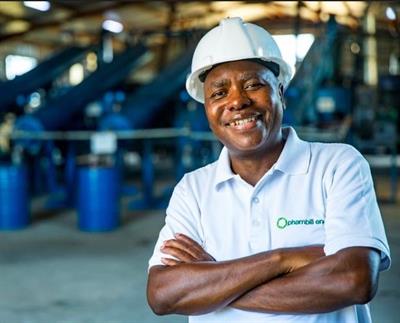
Musa MSIMANGO
CEO
Phambili Energy
Musa Msimango, Mechanical Engineer, regenerative farmer, and Chief Executive Officer at Phambili Energy. Musa combines 15 years of commercial farming with deep engineering expertise in thermodynamics and fluid mechanics to design and scale modular biomass systems that restore soils, sequester carbon, and create resilient livelihoods.
He leads commercialisation of the Phambili Biomass Conversion Technology and the Jenga Bio Suite, transforming agricultural residues into biochar, bio oil and syngas, then upgrading those streams into market ready products. His flagship innovations include Jenga Bio Forge, a biochar based coking pellet that replaces anthracite for coking coal and power generation—tested and approved in 2025 by several of the world’s largest mining companies as a viable substitute for coking coal and green steel manufacturing—and Jenga Bio Fusion, an engineered root delivery technology that has revolutionised the biofertilizer industry by dramatically improving nutrient delivery, soil health, and crop performance.
Musa is an award winning entrepreneur and pragmatic visionary who positions Phambili Energy as Africa’s flagship contributor to industrial decarbonisation—turning waste into climate solutions, commercial value, and community opportunity.
At Bio360 Europe 2026, Musa will share how African innovation in biomass conversion using the BCT and Jenga Bio Suite can accelerate the global bioeconomy and deliver both climate and economic dividends.
South African Biochar Insights : Individual Journeys, Collective Experience
17/06/2026 at 14:00
South Africa’s biochar sector is reaching an important turning point. For the first time, a unique group of pioneering producers, technology developers and early-stage project leaders will come together for an open discussion on the realities of building a biochar industry within the Sub-Saharan African context. Drawing on hands-on experience from organisations including B10 Char, PyroSA / Pyronam, Phambili Global, MyCHARR, Aquagel and Nhlamunyiko Group, the session will offer delegates a rare opportunity to hear directly from those navigating the technical, operational, financial and market realities of scaling biochar projects in Southern Africa. Through the sharing of individual journeys - each shaped by different feedstocks, technologies, markets, financing pathways and operational contexts - the discussion will help reveal a broader collective experience of the sector, highlighting both the recurring challenges encountered across projects and the areas where approaches are converging around shared lessons - or beginning to diverge as technologies, markets and business models evolve.
Rather than theoretical discussions, the session will focus on practical lessons learned from real projects, real deployment challenges and real commercial experiences encountered along the way. The discussion will explore how producers and developers are approaching feedstock selection, technology pathways, carbon certification, market development and commercial positioning, while also examining where the strongest opportunities are emerging across agriculture, industry, carbon removal and the wider bioeconomy. Delegates can expect candid insight into the successes, setbacks and unexpected realities encountered by first movers in the sector, as well as perspectives on what is still needed - from policy support and infrastructure to financing mechanisms, partnerships and market confidence - to help accelerate biochar deployment across Sub-Saharan Africa. Together, these collective experiences will help provide a grounded and forward-looking picture of where the Sub-Saharan African biochar sector stands today and where it could realistically evolve to over the coming decade.
|
Industrial Biochar Applications for Metallurgy, Construction and Mining Land Rehabilitation
17/06/2026 at 15:30
As biochar markets continue to mature, increasing attention is being given to industrial applications capable of extending its value far beyond agriculture and carbon removal alone. This session will explore how biochar and biocarbon materials are beginning to emerge as strategic tools within industrial decarbonisation pathways, particularly in energy-intensive sectors such as metallurgy, mining and heavy industry. Drawing on international project experience and operational perspectives, the discussion will examine the technical, environmental and commercial realities of integrating biochar-derived materials into industrial processes traditionally reliant on fossil carbon sources.
Alongside industrial applications, the session will also explore the growing role of biochar in land remediation and ecological restoration, particularly in landscapes affected by mining and industrial degradation. Speakers will share insights into how biochar can contribute to soil rehabilitation, contaminant immobilisation, water retention and ecosystem recovery, while simultaneously supporting carbon sequestration and circular resource utilisation. Delegates can expect to gain a clearer understanding of the opportunities, limitations and emerging market pathways for industrial biochar applications, as well as how these approaches may contribute to wider decarbonisation, land restoration and bioeconomy development strategies within African and international contexts.
|
Regenerative Agriculture: Restoring Soils through Biological & Circular Solutions
18/06/2026 at 10:00
Regenerative agriculture is increasingly emerging as a critical intersection point between soil health, nutrient recovery, climate resilience, circular economy development and carbon removal. This session will explore how biological inputs, organic waste valorisation, biofertilisers and biochar-based soil solutions are being deployed to help restore degraded soils, improve crop productivity and reduce dependence on imported synthetic fertilisers. Bringing together pioneers working across waste management, biological agronomy, carbon markets and regenerative farming systems, the discussion will examine how integrated circular approaches can help strengthen both agricultural resilience and local bioeconomies within African and international contexts.
Drawing on operational experience from across the continent, Regen Organics will share insight into its circular economy model transforming urban organic waste streams into valuable agricultural inputs, including organic fertilisers, while also pioneering biochar and carbon credit initiatives in Africa. GreenCell will explore the role of biofertilisers and biological soil enhancement in improving soil health, sustainability and crop yields within emerging agronomic systems. Contributions from Phambili Energy will examine the JengaBio Suite and its approach to biological and regenerative agricultural solutions, while Circular Bionutrient Economy Network (CBEA) and Regen8 / Aquagel will provide broader perspectives on nutrient cycling, soil regeneration, water efficiency and sustainable land management. Delegates can expect to gain practical insight into how regenerative agriculture is evolving from isolated practices into integrated systems linking waste valorisation, biological soil restoration, climate resilience and carbon finance opportunities.
Part 1 (10:00 - 11:30)
CBEA
Regen Organics
Greencell
Carbon Connect
1 hour of presentations and 30 mins of panel discussion / exchange with the floor
Part 2 (11:40 - 13:10)
Phambili Energy
Aquagel
Bioactive Biologics
1 hour of presentations and 30 mins of panel discussion / exchange with the floor
|
|